
Pay Off a Loan Early Calculator: How Extra Payments Cut Interest and Shorten Your Debt Timeline
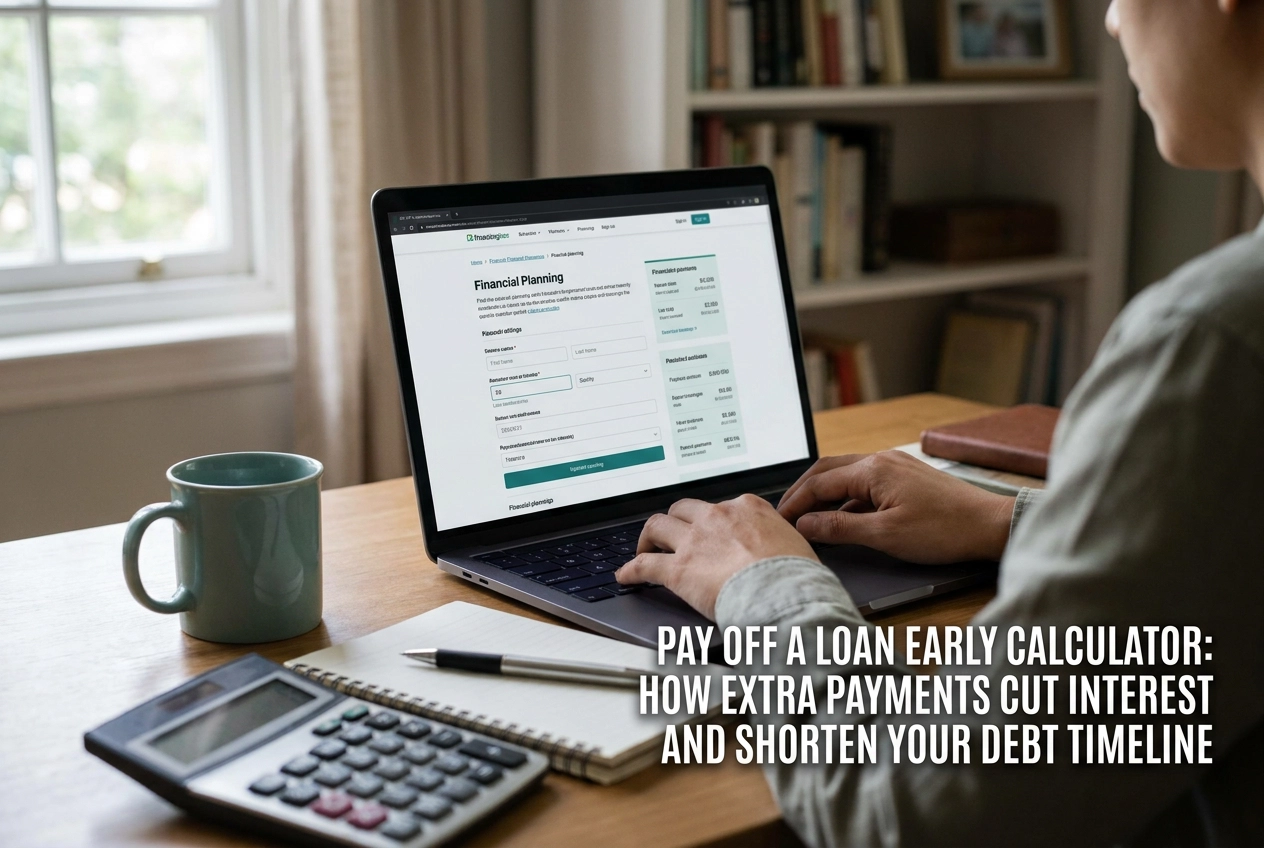
Most people sign a loan agreement and never look past the monthly payment. The total interest? That number quietly sits in the fine print while you make payment after payment for years. By the time you reach the final one, you may have paid thousands more than the original amount you borrowed.
Here is the thing: a pay off loan early calculator with extra payments can show you exactly what that hidden cost looks like, and more importantly, what you can do to shrink it. Even adding one small extra payment per year can knock months off your loan and save you a surprising amount of money.
In this tutorial, you will learn how these calculators actually work, how to use one step by step, and how to model different payment scenarios on a real loan. You will also find five practical ways to make extra payments without stretching your budget, plus a honest look at whether paying off early is even the right move for your situation. No financial background needed. Just a loan balance and a few minutes to run the numbers.
The Number Nobody Checks Before Signing a Loan
When most people apply for a personal loan, one question dominates: Can I afford the monthly payment? That focus is understandable, but it causes borrowers to miss a much bigger number hiding in the fine print.
Take a $15,000 personal loan at 10% APR over five years. The monthly payment runs about $318, which sounds manageable. But by the time you make that final payment, you will have paid roughly $4,100 in interest alone. That is nearly 27 cents in extra costs for every dollar you borrowed.
Lenders are legally required to disclose both your APR and your total repayment amount under the Truth in Lending Act (Regulation Z). The number is on your paperwork. The problem is that when you are laser-focused on whether $318 fits your budget, a total repayment figure rarely gets a second look.
That is exactly where a pay off loan early calculator with extra payments changes things. Instead of just showing your scheduled payoff date, it shows you the total interest saved when you pay more than the minimum. That savings figure, not the date, is the number that actually moves the needle on your finances.
Understanding the gap between what you borrowed and what you ultimately pay is the foundation of smarter debt decisions. The four numbers you need to run those calculations are simpler than you think.
What an Early Payoff Calculator Actually Does
So how does one of these tools actually work?
A personal loan payment calculator needs four inputs: your current loan balance, your interest rate (APR), your remaining term in months, and the extra payment amount you want to test. That last field is where the magic happens.
Once you enter those numbers, the calculator runs two amortization schedules side by side: one showing your loan paid off on the original timeline, and one showing what happens when you add extra money each month. The difference tells you exactly how many months you save and how many dollars you save in interest.
That interest savings figure is the output worth focusing on. The new payoff date is satisfying, but the dollar amount proves whether extra payments are worth it in practical terms.
Free calculators, including the one at can-i-afford-it.org, let you run as many scenarios as you want before committing a single extra dollar. Test $25/month. Test $100/month. Test one lump sum per year. Each scenario takes about 30 seconds.
Some calculators also display a month-by-month breakdown of how much of each payment goes to principal versus interest. Watching your balance drop faster in the accelerated column makes the math feel concrete rather than abstract. If you want to see your debt-free date mapped out visually, that breakdown is the clearest way to get there.
How to Use the Pay Off Loan Early Calculator: Step by Step
Now that you know what the calculator does, here is how to put it to work in about five minutes.
Step 1: Gather your loan details. Pull up your most recent statement or log into your lender's account portal. You need three numbers: your current balance, your interest rate (APR), and the number of months remaining on your loan.
Step 2: Enter your current payment. Type in your regular monthly payment. This gives the calculator a baseline so it can show you exactly what you are on track to pay if nothing changes.
Step 3: Add a small extra payment. Start with $25 or $50 per month. You do not need a big number to see a real difference in your total interest and payoff date.
Step 4: Compare the outputs. Focus on three figures side by side: months saved, total interest under your original plan, and total interest under the new plan. The gap between those last two numbers is your potential savings.
Step 5: Run multiple scenarios. Try $50 extra per month, then $100, then a one-time annual lump sum like a tax refund. Each scenario takes seconds to model. Comparing them helps you find the option that actually fits your budget. You can also plug your debt numbers into a broader debt payoff tool to see how this loan fits alongside other balances.
Step 6: Check for prepayment penalties before you act. Some personal loans charge a fee for paying off early, which could partially offset the savings you just modeled. Confirm the policy with your lender before sending any extra money.
Real Numbers: Three Scenarios on a $15,000 Personal Loan
Let's put those steps to work with actual numbers. All figures below assume extra payments are applied directly to principal each month, confirm this with your lender before you start.
Baseline: $15,000 at 8% APR over 60 months. Standard payment: ~$304/month. Total interest over the life of the loan: ~$2,240.
Scenario | Extra Payment | Months Saved | Interest Saved | New Total Interest |
|---|---|---|---|---|
Baseline | $0 | 0 | $0 | ~$2,240 |
A | $50/month | ~9 months | ~$375 | ~$1,865 |
B | $100/month | ~16 months | ~$640 | ~$1,600 |
C | One payment/year (~$304 each December) | ~5-6 months | ~$290 | ~$1,950 |
Scenario A costs about the same as a streaming service. Scenario B recovers more than half a standard monthly payment in saved interest. Scenario C requires zero monthly budget change; you simply make one deliberate lump-sum payment once a year.
The bigger point: none of these require a windfall. Small, consistent additions outperform waiting for the perfect moment. Just as the 15% guideline helps you set a spending ceiling on a car, a target extra-payment amount gives your loan payoff a number to aim for. The calculator shows you which scenario actually fits your cash flow.

Five Ways to Make Extra Payments Without Blowing Your Budget
The scenarios above prove the math works. Here is how to find the cash without straining your budget.
Round up your payment. If your standard payment is $304, pay $350. The extra $46 goes straight to principal every month, and most people barely notice the difference in their checking account.
Apply windfalls to principal. Tax refunds, work bonuses, and cash gifts are ideal for a one-time lump-sum payment. A single windfall applied to principal can eliminate several months of interest at once, with no change to your regular budget.
Switch to biweekly payments. Pay half your monthly amount every two weeks. That produces 26 half-payments per year, which equals 13 full monthly payments instead of 12. You make one full extra payment annually without writing a separate check.
Automate a small add-on. Set up an automatic transfer of $25 or $50 each month, earmarked specifically as an extra loan payment. Automation removes the temptation to spend it elsewhere before the due date arrives.
Redirect a canceled bill or subscription. When an expense disappears from your budget, route that freed-up cash to your loan immediately. Lifestyle inflation tends to absorb available money fast, so act before the spending gap fills itself.
If you are unsure how much cushion you have to work with, if you're behind the benchmark for savings by your age, build that buffer before accelerating your loan payoff.
Should You Pay Off Your Loan Early or Use the Money Elsewhere?
Before you redirect every spare dollar to your loan, it's worth asking whether that's actually the best use of the money. Sometimes it is. Sometimes it isn't.
Here's a simple way to think through it:
Paying down your loan beats a savings account when your APR is above roughly 7-8%. A savings account earning 4-5% doesn't beat a loan costing you 9%. Paying off the loan is a guaranteed, risk-free return equal to your interest rate, and you can't get that anywhere else without taking on some risk.
Credit card debt at 20%+ APR should come first. If you're carrying a balance on a credit card while making extra payments on a lower-rate personal loan, you're losing money on the math. Pay the highest-rate debt first, then redirect that payment to your loan.
Build your emergency fund before accelerating your payoff. Three to six months of expenses in savings isn't optional padding; it's protection. Without it, one car repair or medical bill could push you back into high-interest debt at a worse rate than the one you're trying to escape.
Don't leave a 401(k) match on the table. If your employer matches contributions and you're not capturing the full match yet, that's an instant 50-100% return on your money. No loan payoff strategy beats that.
Once those boxes are checked, run your numbers through a free personal loan calculator, compare the interest savings to your next-best option, and let the math decide. The goal is simply to make each extra dollar do as much work as possible.
Prepayment Penalties: What to Check Before You Pay Extra
Before you act on those calculator results, there is one more thing to verify: whether your loan charges a prepayment penalty.
A prepayment penalty is a fee some lenders charge when you pay off a loan ahead of schedule. It exists to recover a portion of the interest income the lender loses when you exit the loan early.
Not every personal loan has one. Many credit unions and online lenders offer penalty-free loans, but "many" is not "all." Do not assume yours is penalty-free until you confirm it.
Common penalty structures include:
A flat fee, typically somewhere between $150 and $500
A percentage of your remaining balance
A sliding scale that shrinks the closer you get to your original payoff date
To check your loan: search your original loan agreement for the words "prepayment," "early payoff," or "termination fees." If reading the fine print feels unclear, call your lender directly and ask for their prepayment penalty policy in writing.
If a penalty does exist, do not stop there. Add that fee into the calculator alongside your extra-payment scenario. In many cases, the total interest savings still exceed the penalty, making early payoff worthwhile. But you need to run the actual numbers rather than guess. A penalty that looks discouraging upfront sometimes costs far less than the interest you would otherwise keep paying.
Frequently Asked Questions About Early Loan Payoff
Does paying extra always go toward principal? Not automatically. Many lenders apply extra funds to your next due date instead of your principal balance. To make sure your extra payment reduces what you owe, contact your lender in writing or log into your account and designate the amount as a principal-only payment.
How accurate is a free personal loan calculator? Very accurate for fixed-rate loans, which follow standard amortization math. If your loan has a variable rate or fees rolled into the APR, results may vary slightly. Use the calculator as a reliable planning tool, not a guarantee.
What is an estimated monthly payment vs. your actual payment? A calculator assumes a fixed rate and clean amortization. Your real payment may be higher if your loan includes origination fees, insurance add-ons, or a variable rate component. Always compare the calculator output against your actual loan statement.
Can this calculator work for auto loans or mortgages? Yes. The math is identical for any fixed-rate installment loan. Enter your current balance, interest rate, remaining term, and extra payment amount, and the results are just as useful.
How much does one extra payment per year actually save? On a $15,000 loan at 8% APR over five years, one extra standard payment annually saves roughly $290 in interest and shortens the loan by about five to six months. That is a meaningful result with no change to your monthly budget.
Your Next Steps: Turn the Calculator into a Plan
Now that you have the answers to your most common questions, it is time to act on them.
Start here: Pull out your most recent loan statement and note three numbers: your current balance, your APR, and your remaining term in months. You need these before the calculator can tell you anything useful.
Then run three scenarios using the free pay off loan early calculator at can-i-afford-it.org: a small monthly add-on (say, $25 to $50), a larger monthly add-on (around $100), and one lump-sum extra payment per year. Write down the total interest saved for each. That single comparison tells you more about your loan than anything else on your statement.
Next, weigh those savings against your other priorities. If you are missing an employer 401(k) match, capturing it beats prepaying almost any loan. If credit card debt is sitting at 20% APR, pay that first. Your extra dollar should go where it earns or saves the most.
Before sending a single extra dollar, check your loan agreement for prepayment penalties and confirm with your lender that extra payments will apply to principal, not your next due date.
If the budget is tight, start with $25 a month. It is a real, calculable win, and it builds the habit of treating your finances as something to optimize, not just manage.
Conclusion
Early loan payoff is not about being aggressive with money; it is about being intentional with it. The core lessons here are simple: small extra payments compound into real interest savings, the timeline shrinks faster than most borrowers expect, and a free calculator removes all the guesswork.
Before paying extra, verify there are no prepayment penalties and confirm payments hit principal. Before deciding where your extra dollar goes, compare your loan's APR against other financial priorities.
The hardest part is starting. Run three quick scenarios at can-i-afford-it.org, write down the numbers, and let the math make the decision for you.
Even $25 a month moves the needle. You borrowed the money on someone else's terms; paying it off early means finishing on yours.
Run your own numbers
Rent Affordability Calculator
LiveFind a rent that fits your income comfortably.
Car Affordability Calculator
LiveSee what car payment your budget can handle.
Emergency Fund Calculator
LiveWork out how big your safety net should be.
Debt Payoff Calculator
LivePlan a realistic path to becoming debt-free.
Monthly Survival Number Calculator
LiveKnow the minimum you need each month.
Move Out Calculator
LiveCheck if you're ready to live on your own.
Home Affordability Calculator
LiveSee how much house you can really afford.
Cost of Living Calculator
LiveSee if a rising cost of living still fits your budget.
How Much of My Income Should Go to Rent?
LiveCheck your rent against the 30/40/50% guideline thresholds.
Mortgage Payoff Calculator
LiveSee how much sooner extra payments clear your mortgage.